
What's That Term: Infrastructure as Code for Facilities Management Systems
Written By: Luke Ross
If you manage or oversee a commercial facility, you know that keeping building systems running smoothly is a constant balancing act. HVAC controls, lighting schedules, access systems, and network infrastructure all demand attention, and when changes need to be made, the process can feel slow and error-prone. That is where Infrastructure as Code, or IaC, comes in. Originally a concept from the software development world, IaC is finding new relevance in how we think about managing the technology behind modern buildings and facilities. In this installment of our "What's That Term" series, we will break down what IaC means, where you may have already encountered it, and why it matters for facilities management in the Central Valley and beyond.
What is Infrastructure as Code?
Infrastructure as Code is a method of managing and provisioning technology resources through code and configuration files rather than through manual processes. Instead of logging into individual systems, clicking through menus, and making one-off changes by hand, IaC allows administrators to define how an environment should be set up in a written template. That template can then be applied consistently, repeatedly, and accurately across an entire infrastructure.
Think of it like a recipe. Rather than relying on memory each time you prepare a meal, you follow a written set of instructions that produces the same result every time. IaC works the same way for technology environments. It captures the desired state of servers, networks, software configurations, and connected devices in a format that can be versioned, reviewed, and reused. This approach reduces human error, speeds up deployment, and makes it far easier to scale or replicate environments when needed.
In a facilities management context, IaC principles can be applied to building automation systems, sensor networks, and the IT infrastructure that supports day-to-day operations. When a property manager needs to roll out a new access control configuration across multiple buildings, for example, IaC allows that change to be scripted once and deployed everywhere, rather than repeated manually at each location.
Where You've Heard It Before
You may not have encountered the term "Infrastructure as Code" directly, but the concept has been shaping modern technology for years. Here are some places where IaC is already making an impact.
Cloud Computing Platforms
Major cloud providers like Amazon Web Services, Microsoft Azure, and Google Cloud all rely heavily on IaC tools. Services like AWS CloudFormation and Azure Resource Manager allow businesses to define their entire cloud infrastructure in code, spinning up servers, databases, and networks with a single command. If your organization uses any cloud-based tools, there is a good chance IaC is working behind the scenes.
DevOps and Software Development
IaC is a cornerstone of the DevOps methodology, which focuses on breaking down barriers between software development and IT operations. Development teams use IaC tools like Terraform, Ansible, and Puppet to automate the creation of testing and production environments. This automation ensures that code is tested in environments identical to where it will actually run, reducing bugs and deployment failures.
Smart Building Technologies
Building management systems are increasingly adopting programmable, software-defined approaches. Modern HVAC controllers, lighting systems, and IoT sensor networks can be configured and managed through centralized platforms that share DNA with IaC principles. When a facilities team defines environmental settings, schedules, and alert thresholds in a centralized configuration rather than adjusting each device individually, they are borrowing directly from the IaC playbook.
Large-Scale IT Deployments
Any organization that needs to manage dozens or hundreds of devices, such as workstations, routers, switches, or IoT endpoints, benefits from IaC. Rather than configuring each device by hand, IT teams write configuration scripts that ensure uniformity and compliance across the board.
Why IaC Matters for Facilities Management
Facilities management has traditionally been a hands-on discipline. Technicians walk through buildings, adjust thermostats, replace hardware, and troubleshoot individual systems. While that hands-on presence is not going away, the technology layer that supports modern facilities is growing more complex every year. IaC offers a way to manage that complexity more effectively.
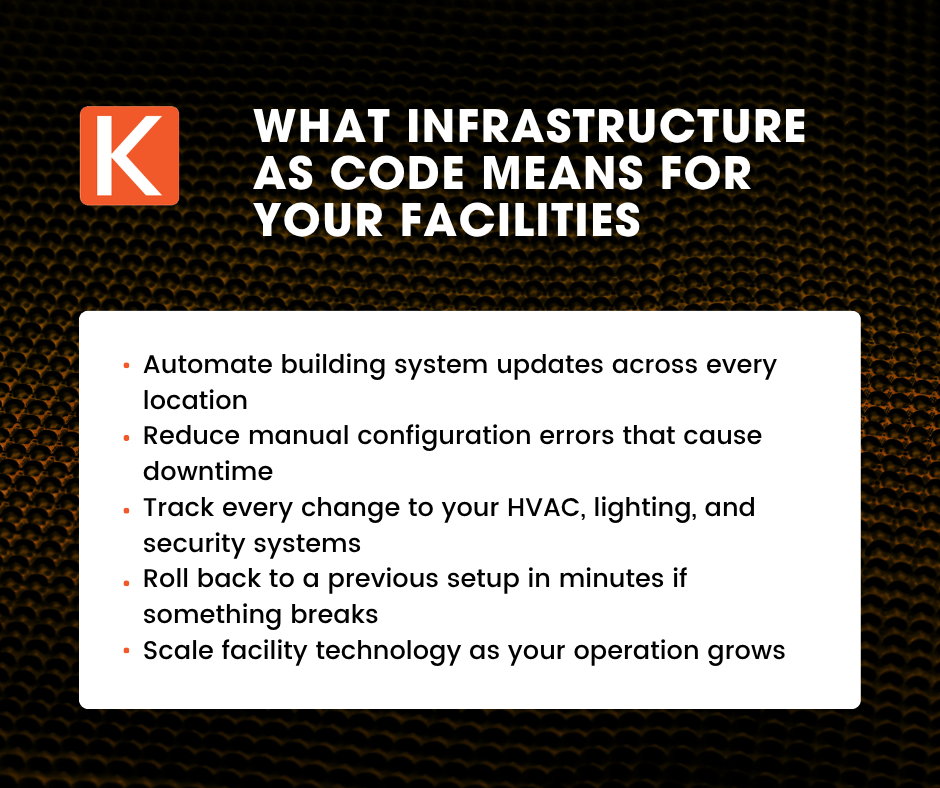
For organizations in the Central Valley that manage multiple properties, such as agricultural processing facilities, office complexes, or construction staging areas, IaC can mean the difference between spending hours configuring each site individually and deploying standardized configurations across every location in minutes. It also provides a clear audit trail. Because every change is captured in code, facility managers can see exactly what was changed, when, and by whom. This level of documentation supports compliance requirements and simplifies troubleshooting when something goes wrong.
Perhaps most importantly, IaC reduces the risk of configuration drift, which is what happens when individual systems gradually fall out of alignment with each other due to one-off manual changes. Over time, drift leads to inconsistencies that are difficult to diagnose and expensive to fix. By defining the desired state in code and reapplying it regularly, facilities teams can keep their environments consistent and predictable.
Key Benefits of IaC for Building and Facility Operations
Understanding the advantages of Infrastructure as Code helps illustrate why this approach is gaining traction outside traditional IT environments. Here are some of the most significant benefits for facilities management teams:
Consistency Across Multiple Sites
When building configurations are defined in code, every location receives the same setup. Whether you are managing three offices or thirty agricultural facilities, IaC ensures that network configurations, security settings, and automation rules are applied uniformly.
Faster Deployment and Recovery
Provisioning new systems or recovering from failures is dramatically faster when you can apply a predefined template rather than rebuilding from scratch. This speed is especially valuable during IT disaster recovery scenarios, where every minute of downtime has a tangible cost.
Reduced Human Error
Manual configuration is inherently prone to mistakes. A mistyped IP address or a skipped step can cause cascading issues that take hours to resolve. IaC eliminates much of this risk by automating the process and ensuring that the same steps are followed every time.
Improved Collaboration Between Teams
Because IaC configurations are stored as text files, they can be reviewed, discussed, and approved by multiple team members before being applied. This collaborative approach brings the same rigor to infrastructure management that code reviews bring to software development.
Our Advice for Getting Started with IaC
If you are considering how Infrastructure as Code principles might benefit your facilities or IT operations, here are a few practical steps to move in the right direction.
Here are five strategies to help you begin incorporating IaC into your environment:
1. Start with a Technology Assessment
Before adopting any new approach, it helps to understand where you stand today. Conduct an assessment of your current infrastructure, including building automation systems, network equipment, and connected devices. Identify which systems are already manageable through software and which still require manual intervention.
2. Identify Repetitive Configuration Tasks
Look for tasks that your team performs repeatedly across multiple systems or locations. Setting up new workstations, configuring network switches, or applying security policies are all strong candidates for automation through IaC. Start with one or two of these tasks to build confidence and demonstrate value.
3. Choose the Right Tools for Your Scale
IaC tools range from enterprise-grade platforms like Terraform and Ansible to simpler scripting approaches using PowerShell or Bash. The right choice depends on the size and complexity of your environment. A managed IT partner can help you evaluate options and select tools that fit your needs without overcomplicating things.
4. Build Version Control into Your Workflow
One of the biggest advantages of IaC is the ability to track changes over time. Store your configuration files in a version control system so that every update is documented. This practice makes it easy to roll back changes if something goes wrong and provides a clear record for compliance and auditing purposes.
5. Partner with Experienced IT Professionals
IaC is powerful, but implementing it effectively requires expertise. Working with a team that understands both the technology and the operational realities of facilities management ensures that your adoption is smooth and sustainable. At Kotman Technology, we help Central Valley businesses align their IT infrastructure with their operational goals, making sure the technology works for you rather than the other way around.
These strategies can help you take the first meaningful steps toward a more automated, consistent, and efficient approach to managing your facilities technology.
Conclusion
Infrastructure as Code is a term that may sound like it belongs exclusively in the world of software development, but its principles are increasingly relevant to anyone managing complex building systems and IT environments. By treating infrastructure configurations as code, facilities teams gain consistency, speed, and reliability that manual processes simply cannot match. Whether you are managing a single office or a network of properties across the Central Valley, IaC offers a smarter way to keep your technology in line with your goals. If you are ready to explore what this approach could look like for your organization, reach out to Kotman Technology to start the conversation.
Kotman Technology has been delivering comprehensive technology solutions to clients in California and Michigan for nearly two decades. We pride ourselves on being the last technology partner you'll ever need. Contact us today to experience the Kotman Difference.