
The Future of Biometric Security for Construction Site Access Control
Written By: Jon Kotman
A construction site is one of the most access-intensive environments in any industry. On any given day, general contractors, subcontractors, material suppliers, safety inspectors, equipment operators, and project owners may all need to move through the same gate. Managing who belongs there, when they're authorized, and whether safety requirements have been met is a logistical and security challenge that traditional keycards, PIN codes, and sign-in sheets have struggled to address reliably.
Biometric technology is changing that equation. Fingerprint scanners, facial recognition systems, iris readers, and vein pattern authentication are no longer science fiction or luxury items for high-security facilities. They're increasingly practical tools for construction companies that want better accountability, stronger site security, and cleaner workforce data. Here's a look at where the technology stands today and what it means for the future of construction site access.
What Makes Biometrics Different from Traditional Access Methods
Traditional access control depends on something a person has (a keycard or badge) or something they know (a PIN or password). Both are vulnerable in the same fundamental way: they can be shared, lost, stolen, or forgotten. In a construction environment with hundreds of workers and significant subcontractor turnover, those vulnerabilities multiply quickly.
Biometrics authenticate based on something a person is, making credentials inherently non-transferable. You can't lend someone your fingerprint, and a facial recognition system won't grant entry to a badge holder who has left the project. This shift from possession-based to identity-based authentication closes a category of risk that has always existed with traditional methods.
For construction firms, this has practical implications beyond just security. Biometric systems generate accurate, tamper-resistant records of who was on-site, when they arrived, when they left, and where they went within a facility. That data has real value for workforce management, payroll verification, OSHA compliance documentation, and incident investigations.
Current Biometric Technologies Used on Job Sites
The landscape of biometric options available to construction companies has expanded significantly, with different technologies suited to different site environments and risk profiles:
Fingerprint Scanning
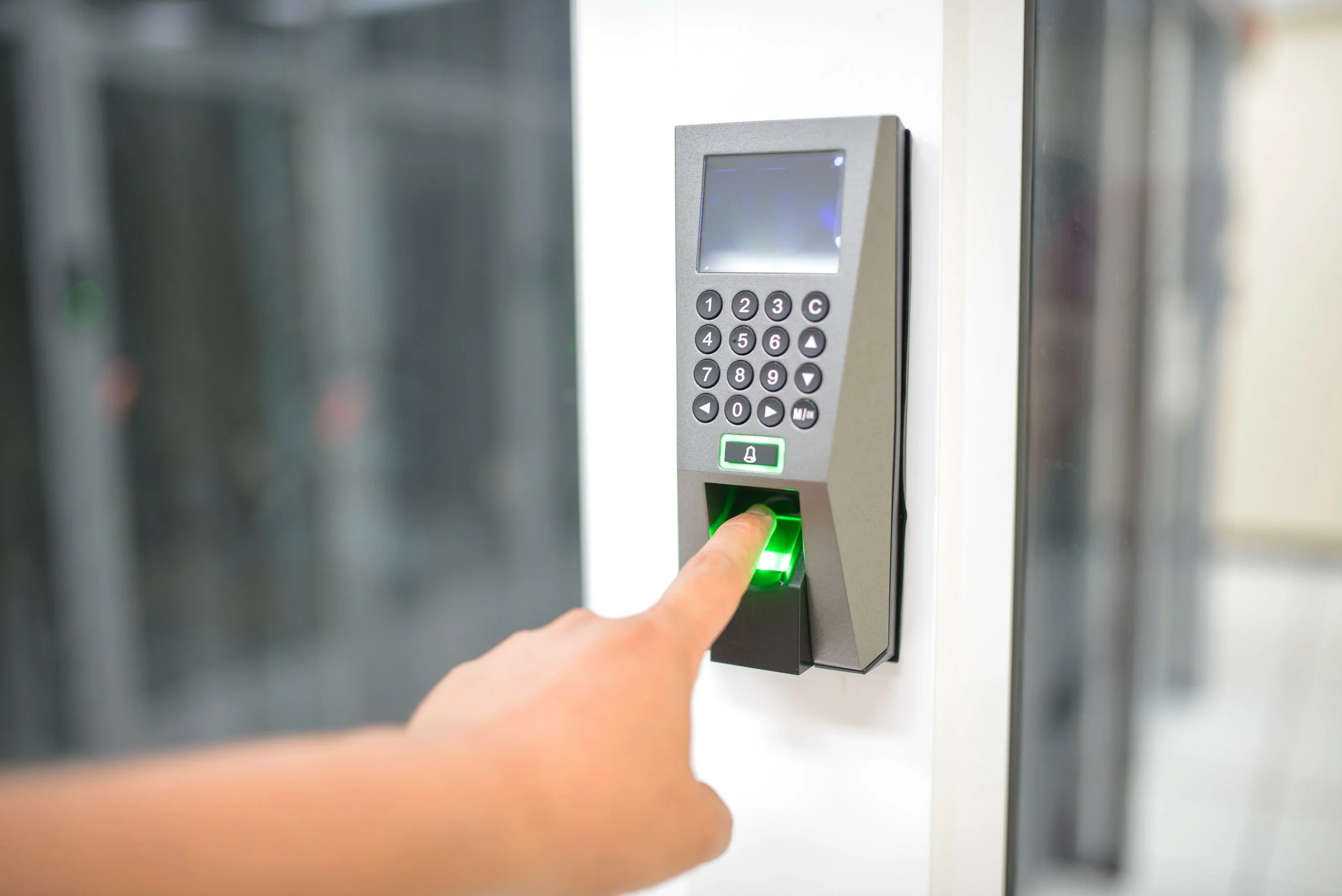
Fingerprint scanning remains the most widely deployed biometric method. It's cost-effective, fast, and supported by a large vendor ecosystem. The main limitation is performance in environments with dirty or wet hands, which is common on active construction sites.
Facial Recognition
Facial recognition has become considerably more accurate and affordable. Modern systems can authenticate in under a second and function effectively even with safety helmets and masks, depending on the system configuration. Some integrate directly with existing security camera infrastructure.
Iris Recognition
Iris recognition offers extremely high accuracy with minimal physical contact, making it well-suited to environments where hygiene or gloves are a factor. It tends to carry higher upfront costs but is increasingly used in higher-security commercial and infrastructure projects.
Palm Vein Scanning
Palm vein scanning uses near-infrared light to map vein patterns beneath the skin. It's highly resistant to spoofing and works well in rough environments where surface-level biometrics like fingerprints may struggle.
Voice Recognition
Voice recognition is less common for physical access but has applications in remote check-in scenarios or environments where hands-free authentication is preferable.
Many deployment scenarios combine biometrics with one additional factor, such as a PIN or proximity card, creating a layered access system that balances speed with security.
Key Benefits for Construction Operations
The value proposition for biometric access control in construction extends beyond keeping unauthorized people out. Here is what modern deployments are delivering for firms that have adopted these systems:
Elimination of Buddy Punching
Time theft through buddy punching, where one worker clocks in on behalf of an absent colleague, is a long-standing problem in industries with hourly labor forces. Biometric time and attendance systems eliminate this practice entirely, because a fingerprint or face can't be borrowed. For projects with large hourly crews, the financial impact of eliminating buddy punching alone can justify implementation costs.
Accurate Subcontractor and Visitor Tracking
General contractors have a legal and operational obligation to know who is on their site at all times. Biometric systems create a definitive record without relying on manual sign-in processes that are easily skipped or falsified. In the event of an incident or inspection, that record is immediately available and difficult to dispute.
Integration with Safety Compliance Systems
Leading biometric platforms now integrate with training and certification tracking systems, so access can be conditionally granted based on whether a worker's safety credentials are current. If a confined space entry certification has lapsed, the system can deny access to relevant site areas automatically, reducing liability and reinforcing compliance culture.
Reduced Credential Management Overhead
Managing hundreds of keycards across a multi-phase construction project, issuing new cards when they're lost, and deactivating cards when subcontractors rotate off the job, is time-consuming and error-prone. Biometric credentials don't need to be issued or revoked in the same way. Enrolling and removing a worker from the system is faster and more reliable, and there's no physical credential to track.
Stronger Perimeter Security on Remote Sites
Many Central Valley construction and infrastructure projects operate in areas with limited physical security presence. Biometric access points can function autonomously, connecting via cellular or local networks to log events and flag anomalies without requiring a guard on-site at every entry point.
Cybersecurity Considerations for Biometric Systems
Biometric data is among the most sensitive personal information a business can hold. Unlike a password, a compromised fingerprint template or facial recognition dataset cannot be changed. This places significant responsibility on the companies deploying these systems to handle biometric data securely.
Key cybersecurity considerations include:
Encryption at rest and in transit: Biometric templates should never be stored or transmitted in plain text. Strong encryption standards should govern all data movement within the system.
On-device vs. cloud storage: Many modern biometric devices store templates locally on the reader itself rather than in a centralized database, which limits exposure. Understanding where data lives is a critical question when evaluating vendors.
Access to the management platform: The software that administers your biometric system is itself a high-value target. Applying strong access controls and multi-factor authentication to that platform is essential.
Vendor security posture: Choosing a biometric vendor with a strong security track record, clear data governance policies, and regular software updates is as important as the hardware specifications.
Working with an experienced IT partner during vendor evaluation helps ensure these questions are asked and answered before deployment, not after a problem occurs.
Integration with Broader IT and Security Infrastructure
Biometric access control doesn't operate in isolation. The most effective deployments connect with existing IT systems to create a unified picture of access, identity, and activity across the organization. That integration might include:
HR and payroll systems for automatic enrollment and offboarding tied to employment status
Project management platforms to tie access events to specific project phases and budget tracking
Incident response frameworks so that an unusual access pattern triggers a notification to the appropriate team
Construction companies working through digital transformation are finding that biometric systems fit naturally into a broader technology modernization effort. Rather than treating physical security and IT security as separate concerns, integrated deployments treat them as two parts of the same operational picture.
For firms managing multiple active sites across the Central Valley, a managed IT partner can help coordinate these integrations, maintain the underlying network infrastructure biometric systems depend on, and ensure the security of the data those systems generate.
What to Expect Looking Ahead
Biometric technology in construction will continue to evolve. Contactless systems, driven in part by increased hygiene awareness, are gaining ground. AI-enhanced facial recognition is improving accuracy in challenging outdoor conditions. Wearable biometrics that continuously verify identity throughout a shift, rather than just at entry points, are in development for higher-security applications.
The broader trend is toward access control that is both more seamless and more accountable. Workers move through sites faster, with less friction. Project owners and safety managers get better data. And security teams have a more complete picture of who was where and when.
Kotman Technology has supported construction and design-build businesses across the Central Valley in building IT infrastructure that keeps pace with the industry's evolving technology demands. If your firm is exploring biometric access systems or wants to understand how they fit into your broader security posture, we're ready to help you think it through.
Kotman Technology has been delivering comprehensive technology solutions to clients in California and Michigan for nearly two decades. We pride ourselves on being the last technology partner you'll ever need. Contact us today to experience the Kotman Difference.